
I have prolapse. Now what?
Can I run?
Can I lift weights?
Should I avoid jumping?
What if I feel pressure or heaviness when I exercise?
Am I making my prolapse worse?
Women are talking more openly about pelvic organ prolapse and incontinence, and that is a huge step forward.
But I think we've created another problem.
Women are learning they have options. They're finding pelvic health physiotherapy. They're learning about pelvic floor exercises, breathing, pressure management and pessaries.
But too often, the advice stops at:
Don't do anything that causes symptoms.
And if running causes heaviness?
Stop running.
If lifting weights makes you feel pressure?
Don't lift as heavy.
If jumping makes you leak?
Don't jump.
But what if, instead of spending our lives trying to stay below that symptom threshold, we asked a different question:
Can we move the threshold?
That's what I discussed with physical therapist Caroline Packard, founder of Connect Pelvic Floor Fitness, in Episode 131 of The Pelvic Floor Project.
Caroline has the unique perspective of being both a pelvic health physical therapist and someone who has personally experienced significant urinary leakage and prolapse.
Our conversation wasn't really about finding the perfect prolapse exercise.
It was about something bigger:
How do we help women move beyond symptom management and get back to the activities they actually want to do?
Think about how we treat a knee injury
Anyone who knows me knows I love an analogy.
Imagine you hurt your knee while running.
You go to physiotherapy. Your physio helps you understand what happened and gives you some initial exercises.
Maybe you work on mobility.
Then some strengthening.
Your pain starts to improve.
Great.
But if your goal is to run a 10K, we wouldn't say:
“Your knee doesn't hurt anymore. You're done.”
We would start progressively loading it.
Maybe you walk.
Then walk-run.
Then run a kilometre.
Then three.
Then five.
At some point your knee might start talking to you again.
That doesn't necessarily mean:
Never run again.
It might mean:
Okay. We've found your current threshold.
Now we figure out why.
Is it strength?
Endurance?
Running mechanics?
Training volume?
Did you simply progress too quickly?
Then we work on that and try again.
This is normal rehabilitation.
But when the symptom comes from the pelvic floor, we often treat it very differently.
A prolapse diagnosis doesn't dictate what you can do
One of the most important things Caroline and I discussed is that having prolapse on a physical examination isn't the same thing as being limited by prolapse.
Caroline openly talks about still having prolapse on examination.
So do I.
I've had two vaginal births, and I have prolapse too.
But it doesn't generally affect my day-to-day life.
That's an important distinction.
A prolapse is a change in anatomy. But the degree of anatomical change doesn't perfectly predict how someone will feel.
Some women have significant prolapse and very few symptoms.
Others have relatively minor anatomical changes and experience bothersome pressure, heaviness or discomfort.
So when someone comes into my clinic asking:
“How bad is my prolapse?”
I'm interested in the examination, of course.
But I'm even more interested in:
How is this affecting your life?
What do you want to be doing that you're currently afraid or unable to do?
That's where rehabilitation really begins.
First, understand what you're feeling
Before we start adding exercises, I think education is incredibly important.
The pelvis is difficult to understand because we can't see what's happening inside it.
I use models, pictures, props and sometimes balloons to help people understand what their pelvic organs and pelvic floor are doing.
We might talk about:
pelvic floor strength and relaxation
breathing
abdominal pressure
bowel and bladder habits
constipation and straining
movement patterns
whole-body strength
mobility
nervous-system responses
how you manage pressure when you lift, cough, run or jump
Because prolapse symptoms don't exist in isolation.
The pelvic floor is part of a much larger system.
And once someone understands that system, prolapse often starts to feel much less mysterious — and much less frightening.
Pelvic floor symptoms can be information
This is where my favourite word comes in:
Threshold.
I've been doing more barbell lifting recently.
At lower loads, I don't notice my prolapse at all.
As the weight increases, however, there is a point where I sometimes become aware of pressure or vulnerability in my pelvic floor.
That's information.
Earlier in my training, my threshold wasn't my pelvic floor — it was my neck and shoulder mobility.
As my body adapted, that changed.
The same thing can happen with pelvic floor symptoms.
Imagine you can run three kilometres without heaviness, but at four kilometres you start noticing pressure.
That doesn't necessarily mean your body is telling you:
Running is bad for me.
It may be telling you:
This is my current capacity.
Now we have something useful to work with.
The goal isn't to blow through symptoms
This distinction is important.
I'm not suggesting that you ignore significant heaviness, pain, leaking or other symptoms and force your way through them.
Quite the opposite.
If symptoms appear, get curious.
What changed?
Did you increase the weight?
Did you increase the number of repetitions?
Did you run farther?
Were you holding your breath?
Are you constipated that day?
Are you fatigued?
Did your technique change?
Can you alter your breathing or movement strategy and change the symptom?
Sometimes we continue.
Sometimes we modify.
Sometimes we decrease the load.
Sometimes we need to investigate further.
Your symptoms can help guide those decisions.
Avoidance doesn't build capacity
Years ago, after having my second child, I noticed that I leaked almost immediately when I jumped on our trampoline.
And I decided to experiment.
I knew I had reasonable pelvic floor strength. But I also realized something very simple:
I never jumped on a trampoline.
My body wasn't trained for it.
So I started practising.
I would empty my bladder first and jump until I reached the point where I started leaking. Initially, that happened within seconds.
Then I stopped.
And I tried again another day.
What surprised me was how quickly that threshold changed.
I could jump longer and longer before I leaked.
I wasn't doing endless Kegels between trampoline sessions.
My body was learning how to manage that particular task.
Think about what would have happened if I'd simply said:
I leak on trampolines, therefore I don't jump on trampolines.
Nothing would have changed.
This doesn't mean everyone should go jump until they leak.
It illustrates something important about rehabilitation:
Our bodies adapt to what we progressively ask them to do.
There is a big gap between bridges and running
This is something Caroline and I kept coming back to.
A woman wants to return to running.
She's given breathing exercises, bridges, clamshells and pelvic floor exercises.
Those might all be perfectly reasonable starting exercises.
But then what?
There is an enormous gap between doing a bridge on the floor and running five kilometres.
Your body has to manage your body weight.
Then speed.
Then repeated impact.
Then fatigue.
Then hundreds or thousands of foot strikes.
The pelvic floor needs to coordinate with the hips, feet, trunk, diaphragm and the rest of the body throughout all of that.
We wouldn't expect an injured runner to do a few clamshells and then magically be ready for a marathon.
Why would we expect that from someone rehabilitating pelvic floor symptoms?
Early symptom resolution is a milestone. It isn't necessarily the finish line.
Sometimes the pelvic floor isn't the place we need to focus
Another misconception is that pelvic floor symptoms always require more pelvic floor strengthening.
They don't.
Sometimes someone needs more strength.
Sometimes they need better pelvic floor relaxation.
Sometimes it's coordination.
Sometimes breathing or pressure management.
Sometimes hip strength or mobility plays a role.
Sometimes we need to look at running mechanics.
And sometimes we need to stop thinking so much about the pelvic floor altogether and simply build a stronger, more capable body.
The pelvic floor doesn't operate independently.
It has to function as part of everything else you do.
Fear can become part of the problem
There is another piece of prolapse rehabilitation that we can't ignore.
Fear.
If you've been told:
Don't lift heavy things because you'll make your prolapse worse, it's pretty hard to walk into a gym and confidently pick up a barbell.
You may brace.
Hold your breath.
Create more tension.
Monitor every sensation.
Wonder whether every bit of pressure means you've caused damage.
That protective response is understandable.
But it can also change how we move.
Part of pelvic health physiotherapy can therefore be helping someone understand what's happening well enough that they can begin to trust their body again.
Education matters.
Exposure matters.
Confidence matters.
And those pieces can be just as important as strength.
What if my goal is weightlifting?
Great.
Then your rehabilitation should eventually look something like weightlifting.
What if your goal is running?
Then eventually, we need to prepare you to run.
What if you want to jump on the trampoline with your kids?
Let's figure out how to build toward jumping.
This is where I think we need to move away from generic “prolapse exercises.”
Your program should ultimately reflect your life.
I often draw an imaginary A-to-B line with patients.
Point A: Where are you today?
Maybe you're walking comfortably and doing a few exercises at home.
Point B: Where do you want to go?
Maybe you want to run a 5K and strength train twice a week.
Now our job is to fill in the space between A and B.
There are different ways to bridge that gap
Not everyone needs — or has access to — weekly one-on-one pelvic health physiotherapy.
Cost can be a barrier.
Geography can be a barrier.
Some physiotherapists have more experience with higher-level exercise prescription than others.
Some clinics simply don't have the equipment or space required for progressive strength and impact training.
That's where we need to get creative.
For one person, that might mean continuing with a pelvic health physiotherapist.
For another, it might mean transitioning to a knowledgeable strength professional.
Someone else might use an online program while checking in periodically with their physiotherapist.
Caroline created Connect Pelvic Floor Fitness partly because of this gap.
Her Pelvic Floor Foundations program takes women through a progression from education and breathing through increasingly challenging strength and eventually impact exercise.
An online program won't replace individualized assessment when that's what someone needs.
But for the right person, a structured progression can provide a bridge between basic rehabilitation and returning to higher-level exercise.
The important part is continuing to pay attention to your own body.
You don't need a “safe exercise” list
I get asked this all the time:
Is this exercise safe for prolapse?
I understand why people want an answer.
Unfortunately, there isn't a master list of exercises labelled:
SAFE FOR PROLAPSE
and
DANGEROUS FOR PROLAPSE.
An exercise that feels fantastic for one person may bring on symptoms for someone else.
And an exercise that causes symptoms today may be something your body tolerates beautifully six months from now.
That's why learning to understand your own thresholds is so much more useful than memorizing a list of things you're allowed to do.
Prolapse doesn't have to be the end of the story
If you've been diagnosed with prolapse or experience urinary leakage, I don't want your first thought to be:
What do I have to stop doing?
Instead, I'd like you to ask:
What do I want to get back to?
Then we work backwards.
Understand what's happening.
Settle symptoms that are interfering with daily life.
Identify your current capacity.
Build strength.
Add load.
Add complexity.
Add impact if that's where you want to go.
Pay attention to what your body tells you.
Adjust when necessary.
Then keep building.
Because the goal of pelvic health rehabilitation shouldn't simply be to help you live quietly underneath your symptoms.
The goal should be to help you build the capacity and confidence to live the life you want.
This blog is intended for educational purposes only and does not replace individualized medical advice.
About Caroline Packard
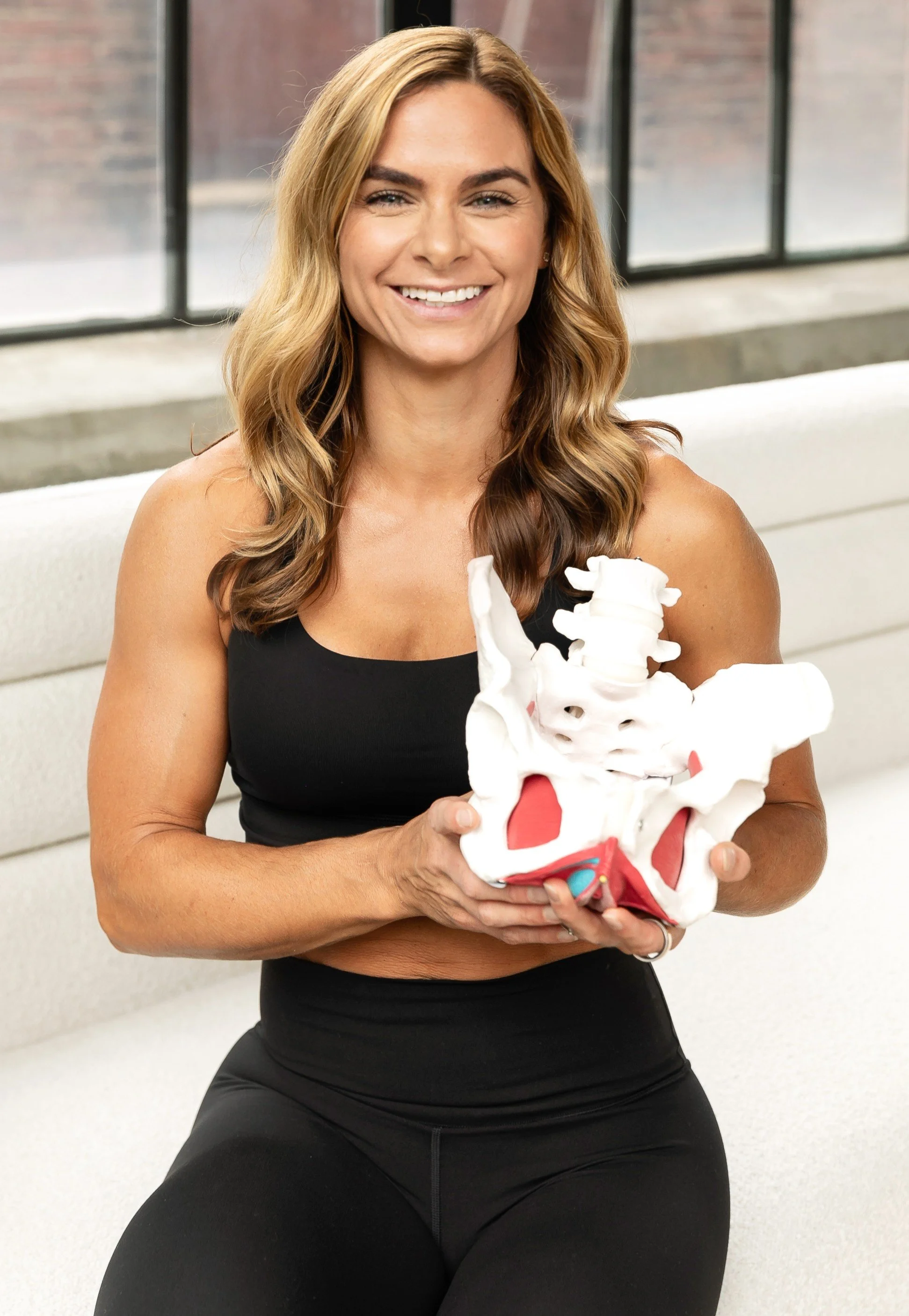
Dr. Caroline Packard, DPT, is a Doctor of Physical Therapy , certified yoga instructor, lifelong athlete, and founder of Connect Pelvic Floor Fitness , an online platform combining pelvic floor education with progressive strength training for women. After navigating her own experience with pelvic floor dysfunction, Caroline built the program she wished had existed: one that leads with education, integrates breath and core function, and builds lasting, functional strength designed specifically for how women’s bodies work. With 15+ years of clinical experience, she is a trusted voice on women’s pelvic health, fitness, posture, and movement. Through the platform and her clinical practice, she's helped more than 100,000 women address pelvic floor dysfunction and rebuild functional strength. Caroline is on a mission to help women understand that they are not broken, and that there is a clear, proven path forward.
Episode Partners
This episode of The Pelvic Floor Project is supported by Embodia and SRC Health, organizations that help make it possible for me to continue creating evidence-based pelvic health education.
Embodia provides online continuing education and mentorship for pelvic health and rehabilitation professionals, including access to courses and expert-led learning from clinicians around the world.
SRC Health creates medical compression garments designed to provide support during pregnancy, postpartum recovery and for women experiencing pelvic health concerns.
Some partner links may be affiliate links, which means I may receive a small commission if you make a purchase, at no additional cost to you. Sponsorship does not influence the topics, guests or educational content of The Pelvic Floor Project.